
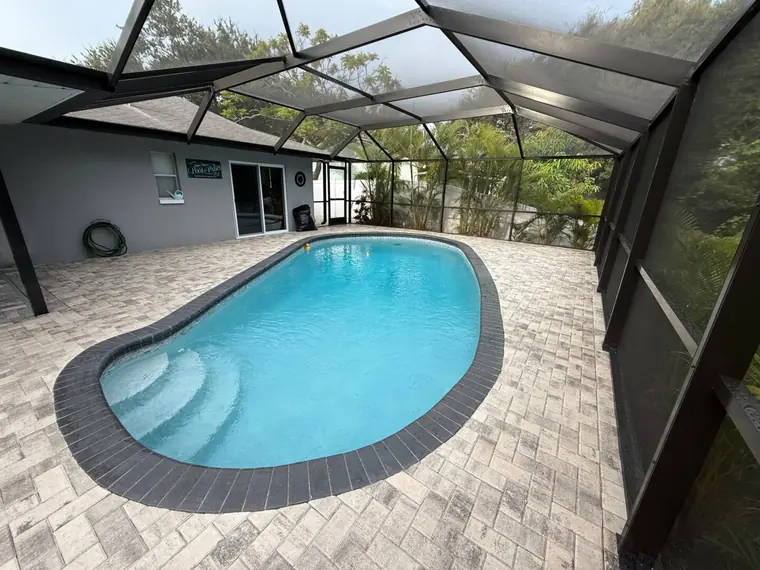
A super gutter on a pool cage is a heavy-gauge aluminum gutter that drains roof and enclosure water while doubling as the main structural beam attaching your cage to the house. If you own a pool in the Tampa Bay area, this one component quietly protects your investment more than most people realize.
Super Gutter Basics: What It Is and How It Works
A super gutter is an extruded, heavy-gauge aluminum gutter designed specifically for screen and pool enclosures. It runs along the roofline where your pool cage meets the house, and it does two jobs at once: it moves water and it holds the enclosure in place.
Here's how it works. The gutter bolts directly to the fascia, and the top rail of your pool cage frame attaches to the gutter itself. So the same piece that catches rain from your roof also supports the enclosure structure. Because of that, it's built with a wider, deeper trough and thicker aluminum than anything you'd find on a typical house.
That extra capacity matters in Florida. When a summer storm dumps water off a large roof and cage surface all at once, the super gutter carries that volume away from your deck and foundation instead of letting it pool where you don't want it.
How a Super Gutter Differs From Standard Gutters
The biggest difference is strength. A super gutter is roughly four to five times thicker than a regular gutter and can be up to twenty times stronger. That's not marketing, it's structural necessity.
A standard gutter only catches water. A super gutter also acts as a load-bearing member, carrying the weight and lateral forces of the entire pool cage. It also comes in larger sizes, commonly 5, 7, 8, and 9 inches, so it can handle the heavy flow that happens right at the transition between roof and enclosure.
Why Super Gutters Matter for Florida Pool Cages and Drainage
In Florida, drainage isn't optional. Our afternoon downpours are famous, and a large roof combined with a pool cage creates a lot of surface for water to run off fast. A properly sized super gutter handles that volume so water doesn't overflow onto your deck or wash toward your foundation.
Without enough capacity, the problems add up quickly. Overflowing water erodes decks, stains pavers, and rots wood fascia and soffit over time. We've replaced plenty of rotted fascia here in the Hudson area that traced back to an undersized or failing gutter.
Super gutters are especially important on large enclosures, two-story pool cages, and steeper roof pitches, where the water load is simply too much for a conventional gutter to manage. Getting the drainage right protects the whole structure, and everything under it.
Super Gutters and Your Roof Options: Panel and Insulated Roof Systems
Super gutters do more than manage screen-roof runoff. They're also key at the transition points where a panel roof or insulated roof system meets your screen room or pool cage.
When you add a solid roof over part of your enclosure, all of that rainwater has to go somewhere. The super gutter collects the runoff and channels it away, while also anchoring the covered structure back to the house. It has to be engineered and sized to match both the roof pitch and the expected water load, there's no one-size-fits-all here.
This is where a lot of DIY or budget jobs fall short. An insulated roof adds weight and sheds water differently than an open screen roof, so the gutter behind it needs to be spec'd accordingly.
Integrating Fascia and Rainwater Management
The super gutter bolts into your fascia boards, which are fastened to the roof structure. Your pool-cage screws then pass through the gutter and into that fascia, tying everything together as one connected system.
That's why fascia condition matters so much. Larger downspouts, typically 3 by 4 inches, are paired with the gutter to match its capacity and carry water well away from slabs and foundations. When the downspouts are undersized, even a great gutter can back up during a hard rain.
Signs You Need a Super Gutter Repair or Upgrade
Most super gutter problems show clear warning signs before they turn into expensive damage. Catching them early saves you money and protects your fascia and deck.
Watch for sagging, separation from the fascia, or loose connections where the cage attaches. Any of these means the structural link between your enclosure and your home is weakening. You should also look for overflow during storms, water pooling near the cage, and staining or rot on the fascia or deck.
Frequent leaks, corrosion, or damage that repairs no longer fix are signs the gutter has reached the end of its life. And if you have an older 5-inch gutter that clearly can't keep up with your roof's runoff, upgrading to a 7-inch super gutter often solves the problem for good. When in doubt, have it inspected, it's a quick check that prevents big repairs.
Choosing and Installing the Right Super Gutter for Your Enclosure
The right super gutter size depends on three things: your roof pitch, your enclosure size, and how much rain your area gets. A 5-inch gutter may work for a smaller cage, while large enclosures, two-story cages, and heavy-rain zones usually call for 7 inches or more.
Professional installation is where the long-term difference shows. Our team assesses the roofline, checks fascia condition, and calculates the enclosure loads before anything goes up. Because the gutter carries structural weight, we reinforce or replace weak fascia rather than bolting into wood that's already compromised.
From there we custom-fabricate the gutter runs, set the proper slope for drainage, and use heavy-duty brackets and marine-grade fasteners built for Florida's salt air and humidity. We integrate the correct downspouts, then test the drainage and connections before we call it done.
We handle super gutter installation and repair as part of our full range of aluminum outdoor structures across Tampa Bay. If you're planning a new pool cage, adding an insulated roof, or fixing a failing gutter, reach out for a free consultation, we'll even show you a 3D rendering so you can see the result before we build.
Getting Your Pool Cage Drainage Right the First Time
A super gutter isn't a small detail, it's the backbone of your enclosure and its first line of defense against Florida rain. Size it correctly, install it into solid fascia, and it protects your deck, foundation, and cage for years. Whether you're building new or repairing an aging system, the right super gutter keeps your outdoor living space dry, sturdy, and worry-free.